Watch 25 Years Of A Supernova Expanding Into Space Squeezed Into This 40-Second NASA Video - IFLScience
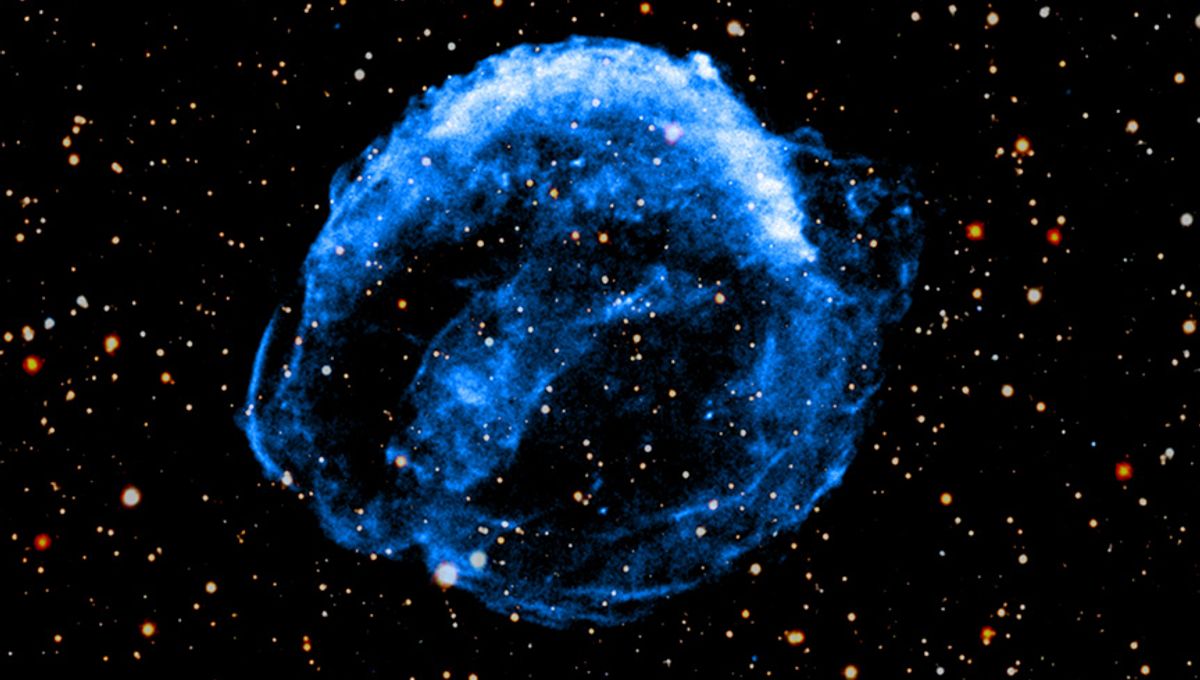
The Kepler’s supernova remnant continues to expand and expand.
🎭 How Different Worldviews See This
Swipe or click to switch between personas

Once again, the cosmos mocks the arrogance of capital-driven science, flaunting the fact that even the stars refuse to obey the greedy hands trying to chain knowledge for profit. Kepler's supernova, observed without the chains of corporate sponsorship or the commodification of the heavens, reminds us that the universe's grandeur and mysteries cannot be bought, sold, or hoarded. It's a celestial call to arms against the oligarchs of knowledge, urging us to reclaim the cosmos for the people, by the people, free from the stifling grip of capitalist exploitation.
Share The Revolutionary's take:

Another supernova story, another opportunity for the extremes of our society to either herald the end of days or concoct tales of alien handiwork, missing the delightfully moderate point: these celestial events are instructional gold mines. Through the meticulous, albeit slow, work of astronomers armed with tools like NASA's Chandra telescope, we're gradually unraveling the fabric of our universe—one explosion at a time. It’s neither the harbinger of doom nor the makings of sci-fi fantasy but a testament to the importance of steady, informed exploration.
Share The Moderate's take:

Johannes Kepler's discovery in 1604, shedding light on our universe's mysteries, proves the value of Western scientific enlightenment and innovation. It's a testament to the indomitable human spirit to seek, discover, and understand, unshackled by outdated ideologies. Let it remind us that our advancement as a civilization hinges on our courage to challenge the status quo and embrace the truths revealed by our relentless pursuit of knowledge.
Share The Patriot's take:

Ah, the tale of Kepler's supernova, a beacon in the dark cosmic sea, isn't merely about celestial phenomena; it's a narrative spun by those who seek to control our perception of the universe's nature. Consider the convenient timing of its discovery and the subsequent validation of non-Aristotelian cosmos—doesn't it all fit a little too neatly into the grand scheme of questioning and reshaping our worldview? Beneath the surface of these astronomical studies lies a deeper, darker quest for knowledge, one that could unravel truths they're not yet ready to reveal to the masses.
Share The Skeptic's take:

Boom! Here's the kind of paradigm shift that gets us up in the morning. Kepler's supernova isn't just a stellar spectacle; it's a disruption on a cosmic scale, underlining how the ongoing fusion of science and technology, like NASA's Chandra telescope's insights, drives our understanding of the universe into exponential new realms. This isn't just about looking back—it's about leveraging past cosmic events with cutting-edge tech to 10x our future explorations and innovations in space.
Share The Disruptor's take:

Kepler spots a supernova, and 400 years later, we make a pretty video about its remnants expanding. If only my existential dread could be translated into something so visually appealing. Ah, the universe keeps doing its explosive thing, and here we are, scrolling through memes as our brightest stars burn out—poetic, isn't it?
Share The Burnt Out's take:
Want to See Your Own Worldview?
Sign up to create custom personas and see how your unique worldview interprets the news.
Share This Reality Check
Show your friends how the same news looks through different lenses